

“A lot of people with high IQs are terrible investors because they’ve got terrible temperaments. And that is why we say that having a certain kind of temperament is more important than brains. You need to keep raw irrational emotions under control. You need patience and discipline and an ability to take adversity without going crazy.”
–Charlie Munger
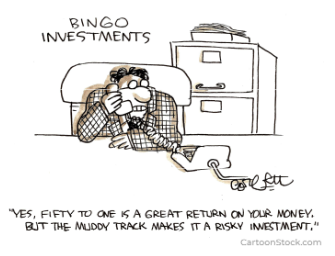
The news cycle is unending and magnifying in volume. Commentators commentate and emotions rise. Participants of markets continuously look for an edge in money making. And according to Rece Davis, an ESPN commentator, all too prevalent sports gambling opportunities are like a “risk-free investment”. Everybody is now an investor.
In the 2023 Berkshire Hathaway letter, significant ink was allocated about “investment temperament”. Buffett describes temperament as desirable attributes required to maintaining control of emotions with an adequate level of understanding regarding a number of topics including accounting, business economics, sensibility (which includes ignoring pundits about short-term predictions), tendencies of humans (like fear, greed), and who to trust (and why).
During most periods of time, temperament skill is not needed. But the temperament skill is absolutely needed during periods of extended gains or losses and especially during occasional periods of short-term paralysis like WWI, WWII, 9/11, etc.
It is likely to be tougher today. Communication is far faster and more voluminous which contributes toward increased influence on individuals. This heavily influences markets as driven by mass psychology. According to Buffett’s perspective, people are NOT more stable today regarding investment temperament because Wall Street is designed for activity, NOT investing. Therefore…..a larger percentage of individuals believing to be “investors” are exhibiting far more “casino-like” behavior today than in previous generations.
Adding to Buffett’s perspective is the reality that most investors don’t directly perform the research and due diligence. The result is far less understanding about the businesses, the assets, and the long-term stability of the underlying assets. This further contributes to increased gambling like activity………which is a poor investment temperament.
So, what is temperament? A person’s character or habit regarding an emotional response.
The following algorithm, if effectively used, will improve one’s temperament.
First, Invest and Avoid Gambling. But what is investing? Investing is NOT the dictionary definition of committing money for expectations of financial gain as this does not exclude several acts considered “gambling” or “speculative”. The proper definition of investing is derived from Ben Graham which states upon thorough analysis, promises safety of principal and a satisfactory return. Operations not meeting these
Second, Be Rational. But what is rational? Rational is having proper reasons or an understanding of reality. If one does not understand
reality, then emotions will overtake decision making thereby increasing the probability of making irrational decisions.
Third, Understand what Situations/Events may cause Emotional Tendencies. Specific situations or events may include negative price fluctuation or volatility, severe or extending economic recessions, political outcomes and events, and other exogenous events. And the world experiences uncomfortable situations every 5-10 years. The negative emotional reactions investors need to avoid relates to strong feelings primarily towards concerns, fears, and even paralysis, but also includes excessive optimism and greed.
Fourth, Control Emotions. Control is obtained by focusing on the “north star” regarding investment decisions, which is best described by the adopted philosophy and principles outlined in the investment policy. The philosophy and principles are designed to be the decision-making guard rails needed during periods of elevated stress, concerns, fears and excessive optimism. Without a “north star” of decision-making, individual emotions will overtake rational decision-making.
It’s simple but not easy….. It requires executing the proper definition of investing with the proper understanding of reality, to be rational, which requires understanding what situations may trigger emotional tendencies which requires focus on long-term investment truism described in the adopted philosophy and principles. When consistently done over decades, despite encountering several periods of uncomfortable situations, the outcome will be able to achieve long-term returns.
“It’s not supposed to be easy. Anyone who finds it easy is stupid.” — Charlie Munger