

“I can calculate the motion of heavenly bodies, but not the madness of people”
Isaac Newton
On December 31, 2024, The Wall Street Journal reported “Stocks Cap Best Two Years in a Quarter-Century.” The story reports investors are far richer, increasingly bullish with expectations of continued interest rate reductions, strong economy and market gains. There are several weaknesses and misguided perspectives about the headline and article. First, what are “stocks”? The article implies “stocks” to mean more than one stock, but which group or collection of companies represents “stocks”? The S&P 500 is the collection of 500 individual companies, but is the S&P 500 representative of all groups of stocks? Second, why only look at 2 years? Is two years considered “long-term” investing or representative of the past or future? Third, the article groups the performance of “stocks” with gold and bitcoin which neither produce a stream of income subjecting each type of asset to speculative activities. But the headline was likely successful by imprinting the misguided notion that “Stocks Cap Best Two Years in a Quarter-Century”.
Markets
The advantage of grouping individual companies into indexes like the S&P 500 is to describe a common characteristic. The common characteristics shared by the individual members of the S&P 500 include; domiciled in the USA, relatively large compared to all public companies and have been profitable for at least one quarter prior to inclusion. There are many differences among the S&P 500 including; sectors, industry and industry sub-groups. In addition, companies have different priorities, strategies, objectives, and leadership. Furthermore, companies have different communication methods, earning expectations, leverage, key performance indicators and owners. There are many more differences than similarities.
Markets within Markets
Perhaps most influentially, market psychology and sentiment will favor or penalize different groups of stocks at different times. Presently the themes of Artificial Intelligence, Mag-7, and blockchain technology dominate market psychology and clearly favored in the last 2 years. In the short run the market is a popularity contest as described by Ben Graham.
S&P 500 is Presently Favored
Indexes used to describe a collection of individual companies may occasionally provide deceiving results. Therefore, it is not helpful nor instructive to look at “stocks” in totality – especially when the group of stocks is market capitalization weighted which automatically adds momentum to the process. Given the top 10 companies of the S&P 500 represent 40% of the index, an outsized impact results from less than 1% of members. Concentration is at an all-time high.
Time Horizon of 3 Years
The two-year timeframe excludes CY 2022 when nearly all markets were impacted by inflation and the nearly 5.0% rise of interest rates over the course of 18 months. The S&P 500 performance was -18% and the Nasdaq was -33% for example. When the 3-year performance is observed, the S&P 500 is at 9.3% which is closer to “long-term” average. But the equal weight S&P 500 only advanced 4.4%, which is less than ½ of the market capitalization weighted index. Furthermore, the International Equity Indexes have returned 0.0% among developed and emerging markets. There is a big difference in performance over 3 years, hence “stocks” have not had the best nor equal performance.
Comparing Industries during down and up years.
In CY 2022, the S&P 500 was down for the year, but several industries were positive. For example, Oil/Gas Industry +70%, Ag Products +39%, Healthcare Distribution +39% and Wireless Service +20%. There are markets within markets.
In CY 2024, the S&P 500 was positive for the year, but several industries were negative. For example, Footwear Industry -49%, Household Appliances -51%, Personal Care Industry -70% and Drug Retailers -82%. There are markets within markets.
History of the Dot.Com
Similarities exist with current equity markets as compared to the dot.com period that ended with a 3-year decline of the S&P 500 index totaling – 40%. Even though the index declined by 40%, nearly 25% of all companies within the S&P 500 generated positive returns. And the reason for positive returns due primarily to a low price relative to near term economics and lack of popularity in the preceding periods favored by dot.com names. A few examples include Lockheed Martin +164%, Allstate Insurance +54%, JM Smucker +93%, Bank of America +39% and Tractor Supply +370%. There are markets within markets.
Bonds
Regarding bond markets, many examples also exist regarding differences of performance within markets. Corporate bond yields are generally priced to reflect strength of credit. Exxon Mobile is judged by rating agencies and investors as having superior credit strength than Oxy Petroleum. During the last 3 years, Exxon bond yields have averaged 0.5% more than treasury yields whereas Oxy Petroleum have averaged 1.5% more than treasury yields. But, on September 30, 2022, the yields on Exxon and Oxy identically priced at 0.75% more than treasury yields providing an opportunity to improve the credit profile for the same yield compensation. There are markets within markets.
A “Stock” Correction?
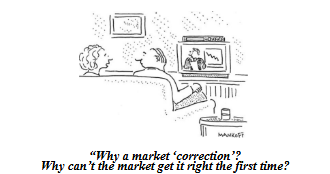
Market sentiment and psychology play large roles in pricing and performance during the short-term. Economics determine the long-term value. Trends, opinions, fads, and groupthink are able to persist for years. Will there be a “correction” in the S&P 500 or other markets?
The higher the price relative to underlying economics, the more a security or investment’s price is supported by market popularity or sentiment. Whenever there is a correction in the S&P 500 “market”…….there will likely be many members that advance in price due to previous neglect and low price relative to near-term economics.