“The essence of investment management is the management of risks……not the management of returns” –Ben Graham
The current investing environment may be classified as “increasing uncertainty” given high inflation, increased geopolitical conflicts, materially higher interest rates, and potential recession among other headwinds. A successful investment operation will own various securities, assets, and businesses that are resilient throughout all periods but especially difficult periods.
The management of risks and potential risks is a central tenet to several of the adopted investment principles. And the principles are designed to provide several decision-making processes which are most useful during periods of increased headwinds or uncertainty.
Risks come in all forms regarding investment decisions. Human involvement brings emotional, temperamental, and short-term thinking risks. Without proper planning, investment decisions may bring liquidity or tax risks. And exchanging cash for a bond or stock brings the risk of losing money. The adopted investment principles include several that relate to risk management. One of the most important parts of the investment decision-making process needs to include “stress testing”.
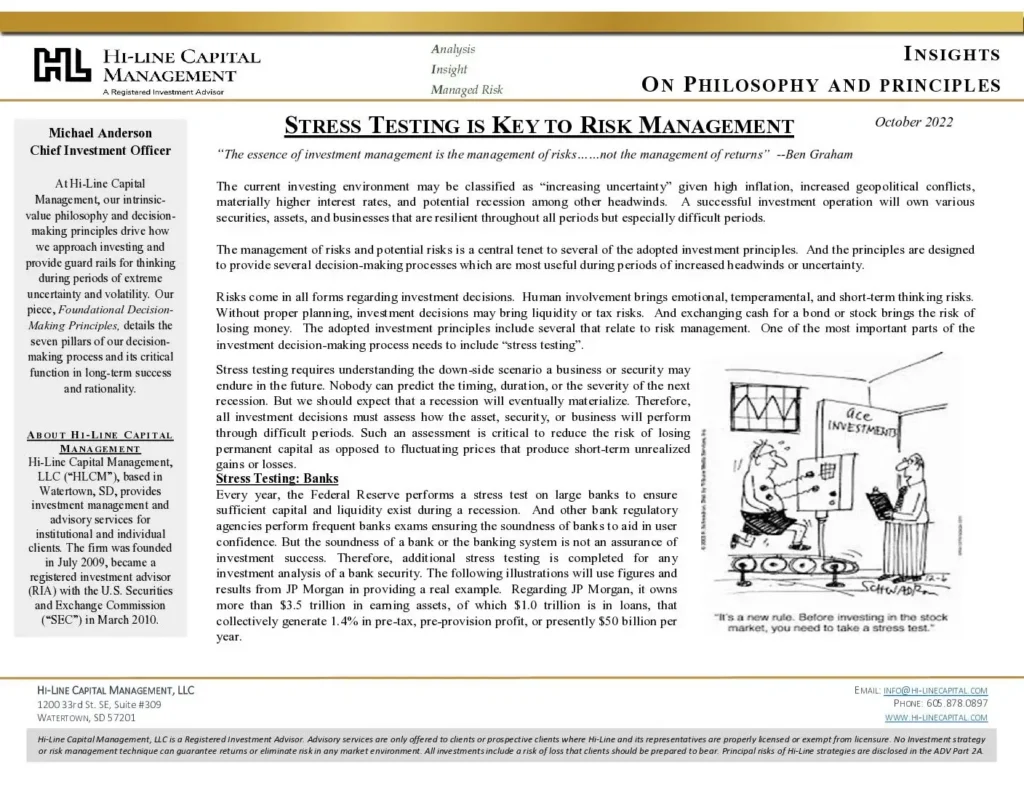
Stress testing requires understanding the down-side scenario a business or security may endure in the future. Nobody can predict the timing, duration, or the severity of the next recession. But we should expect that a recession will eventually materialize. Therefore, all investment decisions must assess how the asset, security, or business will perform through difficult periods. Such an assessment is critical to reduce the risk of losing permanent capital as opposed to fluctuating prices that produce short-term unrealized gains or losses.
Stress Testing: Banks
Every year, the Federal Reserve performs a stress test on large banks to ensure sufficient capital and liquidity exist during a recession. And other bank regulatory agencies perform frequent banks exams ensuring the soundness of banks to aid in user confidence. But the soundness of a bank or the banking system is not an assurance of investment success. Therefore, additional stress testing is completed for any investment analysis of a bank security. The following illustrations will use figures and results from JP Morgan in providing a real example. Regarding JP Morgan, it owns more than $3.5 trillion in earning assets, of which $1.0 trillion is in loans, that collectively generate 1.4% in pre-tax, pre-provision profit, or presently $50 billion per year.

Stress Test: Bank Example #1: Owning the Equity
In normal times, JP Morgan may annually experience 1% of loans “gone bad.” Of the loans that have “gone bad,” roughly 50% of their value may be lost causing 0.5% loan losses on its $1.0 trillion loan portfolio (out of $3.5 trillion in earning assets). This results in “average” annual loan losses of $5.0 billion. This average loss would result in $45 billion in pre-tax income.
During the Great Recession, 2007-2009, JP Morgan experienced loan losses of 3.5% or $35 billion – still less than its $50 billion of pre-tax, pre-provision income it would generate during a one-year period. Loan losses would need to be materially higher than those that occurred during the Great Recession to result in a loss scenario which would not persist each year. Considering that JP Morgan’s capital and liquidity profile is judged “best in class” provides further confidence that owning JP Morgan equity comes with significant downside protection even during periods considered “stressed”. Stressed test passed.
Stress Test: Bank Example #2: Owning the Preferred
The preferred security is senior to common equity but junior to its depositors and debt. Rating agencies (like Moody’s and S&P) will use several financial metrics to determine credit strength. An important metric is often the debt-service coverage ratio defined as the amount of times income covers debt-service obligations. Debt rated “AA” will generally have more than 15 times coverage of income relative to its debt obligations.
A similar analysis should be used for preferred securities to compare net income (after loan losses and taxes) to the preferred dividend obligation. During normal times the coverage is more than 20 times and “AA” rated coverage. During the great financial recession, the coverage was more than 10 times during each of the two years ending 2009 which is better than “BBB” rated debt securities. Stressed test passed.
In Summary
The current investing environment is causing “stress” in investors, but the execution of “stress testing” is an important tool of risk management. A good investment allows investors to “sleep well” even during difficult periods and reduces the probability of losing money on a permanent basis. As one of the Indianapolis ‘500’ winners said: “To finish first you must first finish”.